Coming from EasyLocal 3
This guide walks through porting a TSP program with 2-opt moves from EasyLocal 3 to EasyLocal 4. It follows the program from the problem model through composition and execution to checking the port. You can then look up parameters and tuning or use the comparison tables to find the counterparts of familiar concepts and runners.
Much of your problem-specific code can stay: the solution representation, move logic and cost formulas. The main benefit is in the code around it. Recipes replace manual object registration, one app supplies the command line and interactive tester, and checks that once lived in tester menus can run automatically in your test suite.
The implementations also reduce the work spent around each move. Algorithms, cost components and policies are composed at compile time, allowing direct, inlined calls in place of virtual dispatch. When every component has a delta, evaluating a proposal needs no candidate solution copy; unused tracing is removed at compile time. These savings matter especially when moves are cheap.
The published benchmarks give a concrete comparison: on 7 October 2026, EL4 v4.0.0-alpha.2 versus EL3 v3.4.1 achieved a 1.82× geometric mean speed-up in time per evaluation across the tested problems, algorithms and delta modes. On the 300-city TSP with full deltas, the factors were 5.73× for steepest descent and 2.76× for Simulated Annealing. These are measurements on the same Ubuntu/GCC 16 runner, not a guarantee for every problem: two Assignment descent cases were slightly slower. Compare time per evaluation as well as final cost; different search trajectories can require different numbers of evaluations.
The EasyLocal 3 examples are abridged from the TSP used in the benchmarks, based on easylocal-legacy v3.4.1. The EasyLocal 4 examples come from the tutorial and are compiled and tested at every build.
This section is also a PDF, built with the site.
Before you start
- EasyLocal 4 needs a C++23 compiler (see the quick start). It parses the command line itself and no longer depends on Boost.
- Use
#include <easylocal/easylocal.hpp>instead ofeasylocal.hh, and namespaceeasylocalinstead ofEasyLocal::Core. The nameEasyLocal::Corenow identifies the CMake target provided byfind_package(EasyLocal CONFIG REQUIRED COMPONENTS Core). -
The examples use short namespace aliases in place of
using namespace EasyLocal::Core;:EasyLocal 4namespace el = easylocal; // el::app, el::component, ... namespace runners = easylocal::runners; // runners::FirstImprovement, ...Thus
el::appmeanseasylocal::app. Keep these aliases in a function or source file to avoid introducing them into files that include your headers (see the tutorial conventions). -
Start with the SolutionManager, the cost components and one explorer. Without deltas, the framework evaluates each move on a copy of the solution. Once this version works, add deltas one at a time and check each against full evaluation, as you would with EasyLocal 3's
MoveTester. - Before you start, look up your runners and solvers in the comparison tables. Most have a counterpart; some have a different name, and a few are not available yet.
Two C++ features used below may also be unfamiliar:
inline lets a free function defined in a header appear in several
translation units without causing a multiple-definition error. Use it for
header-defined hooks such as read_solution and describe (step 4). If you
define them in a .cpp file, it is unnecessary. The compiler decides whether
to inline calls for speed independently of this keyword.
[[nodiscard]] asks the compiler to warn when a caller ignores a result.
The library uses it for functions such as check(app, input), a parameter
set's apply, and random_move(explorer, solution, rng). This is why the
examples inspect the check report with if (!report) return 1;. In your own
code, use it where dropping a result would be a bug; the user hooks below do
not need it.
Building without CMake
If your EasyLocal 3 program is built by a makefile, it can stay one:
Building without CMake gives the whole workflow,
from the include path to the libraries of the optional components. Two lines
of the old makefile change: the C++ standard becomes -std=c++23, and
-lboost_program_options goes, since EasyLocal 4 parses the command line
itself. Core still needs no library to link and no -D definition.
Porting the problem
1. The Input
An EasyLocal 3 Input was a class that read its own file in the constructor:
class Input
{
public:
    explicit Input(const std::string& path)
    {
        std::ifstream is(path);
        is >> city_count;
        distances.resize(city_count * city_count);
        for (auto& d : distances)
            is >> d;
    }
    double Distance(std::size_t from, std::size_t to) const;

    std::size_t city_count = 0;
    std::vector<double> distances;
};
In EasyLocal 4, the Input is a plain value. A separate function reads it from a stream (step 4), so you can also construct it in a test or receive it over HTTP:
// Input: the instance, immutable during the search.
struct Tsp
{
    // distance[a][b] is the distance between cities a and b (symmetric).
    std::vector<std::vector<double>> distance;

    std::size_t cities() const
    {
        return distance.size();
    }
};
You can keep accessors such as Distance(from, to): the library never calls
Input members. Data precomputed from the instance can also stay in the Input,
or be computed in the constructor of the service that uses it.
2. The Solution
An EasyLocal 3 State was constructed from the Input and often kept a reference to it:
class Tour
{
public:
    explicit Tour(const Input& in) : tour(in.city_count) {}
    std::vector<std::size_t> tour;
};
In EasyLocal 4, the Solution holds the same data and supports copying, moving and assignment:
// Solution: order[k] is the k-th city visited; after the last city the tour
// returns to order[0].
struct Tour
{
    std::vector<std::size_t> order;
};
- Remove the Input reference. The SolutionManager, explorers, cost
components and deltas already have access to the Input, usually through
input(). The I/O hooks receive it as a parameter. A reference member prevents implicit assignment; a pointer requires every copy to refer to the same Input and that Input to outlive them all. - Let the SolutionManager size the containers when it builds a solution
(step 5). Keep a constructor from the Input only while you still use
operator>>, which reads intoSolution{input}(step 4). - Keep cached data in the Solution if it speeds up evaluation. Update
redundant matrices or counters in
make_move. Use the SolutionManager'shashandequalto exclude them from solution identity when a tabu list or trace compares solutions (see the SolutionManager reference).
3. The Move
An EasyLocal 3 Move typically had a constructor with default arguments, so runners could create a move before filling it. It also supplied the comparison and stream operators required by the framework:
class TwoOpt
{
public:
    TwoOpt(std::size_t first_edge = 0, std::size_t second_edge = 0)
        : first_edge(first_edge), second_edge(second_edge) {}
    std::size_t first_edge, second_edge;
};
bool operator==(const TwoOpt& a, const TwoOpt& b);
bool operator!=(const TwoOpt& a, const TwoOpt& b);
bool operator<(const TwoOpt& a, const TwoOpt& b);
std::ostream& operator<<(std::ostream& os, const TwoOpt& mv);

// in the explorer
mv = TwoOpt(first_edge, second_edge);
In EasyLocal 4, a Move can be a simple struct with public fields:
// Move: reverse the part of the tour between positions i + 1 and j.
struct TwoOpt
{
    std::size_t i;
    std::size_t j;
};
The explorer writes move.i and move.j; the delta cost component reads them.
The explorer's is_valid checks whether these positions form a legal 2-opt
move. Since the fields can be set freely, the examples use struct. A class
with public fields works too; the library never calls a member on a move.
Without a user-declared constructor, TwoOpt is an aggregate. You can create
it as TwoOpt{i, j}, TwoOpt{.i = i, .j = j}, or TwoOpt{} with both fields
zero. The last form lets the cursor in step 7 create a move to fill in.
The comparison and stream operators are optional. Add operator== for the
neighborhood checks; a defaulted
bool operator==(const TwoOpt&) const = default; keeps the type an aggregate.
For display in the tester and reports, provide describe(move) (step 4) or
operator<<. The framework does not call < or !=.
A tabu list needs std::hash and == for the move, unless the explorer
provides a separate tabu_attribute(move).
4. Reading, writing and describing
EasyLocal 3 read the Input in its constructor and used operator>> and
operator<< for the State. The stream operators still work as fallbacks,
so you can keep them during the port and replace them later.
// Read into a default-constructed Tsp, in place of the file constructor.
std::istream& operator>>(std::istream& in, Tsp& tsp);

// Read into Tour{tsp}: on this path the Solution keeps the constructor from
// the Input that step 2 could otherwise drop.
std::istream& operator>>(std::istream& in, Tour& tour);

// Written as it was, by the tester, cli::run and the REST service.
std::ostream& operator<<(std::ostream& out, const Tour& tour);
Dedicated hooks can receive the Input as well as the stream. This is useful when reading a solution: the TSP reader needs the number of cities, which the Solution no longer stores.
Define these free functions alongside your types. The library finds them through argument-dependent lookup and prefers them to stream operators:
read_input(std::type_identity<Input>, in)returns an Input. The type tag selects which Input to read.read_solution(const Input&, std::istream&)returns a Solution.write_solution(const Input&, const Solution&, std::ostream&)writes it.describe(value)provides display text for an Input, Solution or Move.
The tutorial's solution hooks replace the two State operators above:
inline Tour read_solution(const Tsp& tsp, std::istream& in)
{
    Tour tour{std::vector<std::size_t>(tsp.cities())};
    for (auto& city : tour.order)
        if (!(in >> city))
            throw std::runtime_error{"invalid tour"};
    return tour;
}

inline void write_solution(const Tsp&, const Tour& tour, std::ostream& out)
{
    for (const auto city : tour.order)
        out << city << ' ';
    out << '\n';
}
For reading and writing, the library tries a member, a free function, then a stream operator. It uses the first available form, so a hook can override an operator without removing it:
| EasyLocal 3 | EasyLocal 4, in the order the library tries them |
|---|---|
Input(const std::string& path) reading the file |
a static Input::read(in), read_input(std::type_identity<Input>, in), or operator>> into a default-constructed Input |
operator>>(is, State&) |
a static Solution::read(input, in), read_solution(input, in), or operator>> into Solution{input} |
operator<<(os, const State&) |
a member solution.write(input, out), write_solution(input, solution, out), or operator<< |
PrintViolations, "pretty print output" |
describe(input), describe(solution), describe(move), and the describe(solution) of a cost component (step 6) |
The file helpers (load_input, load_solution), interactive tester,
cli::run and REST service all use these same hooks. Your main can leave
file handling to them, and a change to your file format reaches every frontend
through the same implementation
(chapter 6).
5. The SolutionManager
class TspSolutionManager : public SolutionManager<Input, Tour, CostStructure>
{
public:
    explicit TspSolutionManager(const Input& in)
        : SolutionManager<Input, Tour, CostStructure>(in, "TspSolutionManager") {}

    void RandomState(Tour& st) override
    {
        st.tour.resize(in.city_count);
        std::iota(st.tour.begin(), st.tour.end(), std::size_t{0});
        std::shuffle(st.tour.begin(), st.tour.end(), Random::GetGenerator());
    }

    bool CheckConsistency(const Tour& st) const override
    {
        return st.tour.size() == in.city_count;
    }
};
class TourManager : public easylocal::solution_manager_base<Tsp, Tour>
{
public:
    // The constructor of the base: from the Input, which input() gives back.
    using solution_manager_base::solution_manager_base;

    // The cities in index order: 0, 1, ..., n - 1.
    Tour initial_solution() const
    {
        Tour tour{std::vector<std::size_t>(input().cities())};
        std::ranges::iota(tour.order, std::size_t{0});
        return tour;
    }

    // The same cities in a random order.
    template<std::uniform_random_bit_generator RNG>
    Tour random_solution(RNG& rng) const
    {
        auto tour = initial_solution();
        std::shuffle(tour.order.begin(), tour.order.end(), rng);
        return tour;
    }

    // A tour is valid when it is a permutation of 0, 1, ..., n - 1: it has
    // n positions and visits every city exactly once.
    bool is_valid(const Tour& tour) const
    {
        return std::ranges::is_permutation(
            tour.order,
            std::views::iota(std::size_t{0}, input().cities()));
    }
};
| EasyLocal 3 | EasyLocal 4 |
|---|---|
constructor (in, name) |
inherited: using solution_manager_base::solution_manager_base; |
in |
input() |
RandomState(Solution&) with Random:: |
random_solution(RNG&), which returns the solution |
GreedyState(Solution&) |
initial_solution(), which returns the solution |
CheckConsistency |
is_valid: the representation is well formed |
CostFunctionComponents, AddCostComponent |
the recipe (steps 6 and 10) |
LowerBoundReached, OptimalStateReached |
a target cost for the run: stop_at(cost), or --target |
StateDistance |
no counterpart |
PrintState, DumpState |
describe(solution), write_solution (step 4) |
The random construction logic can stay the same. Take the generator as a
parameter, replacing Random::GetGenerator() with rng and
Random::Uniform<T>(a, b) with
std::uniform_int_distribution<T>{a, b}(rng).
6. The cost components
class TourLength : public CostComponent<Input, Tour, double>
{
public:
    explicit TourLength(const Input& in)
        : CostComponent<Input, Tour, double>(in, 1.0, false, "TourLength") {}

    double ComputeCost(const Tour& st) const override
    {
        double total = 0.0;
        for (std::size_t position = 0; position < st.tour.size(); ++position)
            total += in.Distance(st.tour[position],
                                 st.tour[(position + 1) % st.tour.size()]);
        return total;
    }

    void PrintViolations(const Tour&, std::ostream&) const override {}
};
class TourLength : public easylocal::input_base<Tsp>
{
public:
    using input_base::input_base; // constructed from the Input, read by input()

    double evaluate(const Tour& tour) const
    {
        const auto n = tour.order.size();
        double length = 0.0;
        for (std::size_t k = 0; k < n; ++k)
        {
            const auto from = tour.order[k];
            const auto to =
                tour.order[(k + 1) % n]; // the last city goes back to the first
            length += input().distance[from][to];
        }
        return length;
    }
};
ComputeCost becomes evaluate. The optional input_base<Tsp> provides a
constructor from the Input and the input() accessor, with no virtual
functions. A component that needs no Input can stand on its own.
Weights and hard/soft roles now belong to the recipe's cost expression.
Suppose your program has two hard components, H1 and H2, and two soft
components, S1 and S2, with weights 1 and 5. Each is a class with an
evaluate member, like TourLength. Combine them as follows:
el::solution_manager<Manager>()
    | el::cost::hard_soft(
        el::cost::sum(el::component<H1>(), el::component<H2>()),
        el::cost::sum(el::component<S1>(), el::component<S2>() * 5))
cost::hard_soft replaces HARD_WEIGHT with a pair compared
lexicographically. The hard cost decides first; the soft cost breaks ties.
No soft improvement can compensate for a hard violation. If weights within
the hard cost helped guide your search, keep them in the hard sum.
This changes Simulated Annealing's behaviour. Its acceptance probability,
exp(-delta / temperature), needs a scalar delta. For cost::hard_soft, that
delta is the soft-cost change when the hard cost is unchanged, minus infinity
when it improves, and plus infinity when it worsens. The search therefore
always accepts a hard improvement and never accepts a hard degradation. Once
it reaches feasibility, it stays feasible. EasyLocal 3's weighted sum could
instead accept a violation and let the search cross an infeasible region.
To preserve that behaviour, use a single weighted sum, such as
el::cost::sum(el::component<H1>() * 1000, ..., el::component<S1>()), and check
the final solution for feasibility. You can also define your own rule with
cost::apply at the root of the expression (Cost).
For violation reports, replace PrintViolations with the optional
std::string describe(const Solution&) const. It returns text for the tester,
reports or HTTP responses to display. An optional name() supplies the
component name previously passed to the constructor. Without these members,
reports show the component's position and value
(chapter 12).
The cost type follows from the return type of evaluate: an int component
stays int. Use cost::in_order for more than two priority levels, or
cost::objectives for several separate objectives
(chapter 3).
7. The NeighborhoodExplorer
class TwoOptNeighborhoodExplorer
    : public NeighborhoodExplorer<Input, Tour, TwoOpt, CostStructure>
{
public:
    TwoOptNeighborhoodExplorer(const Input& in, TspSolutionManager& sm)
        : NeighborhoodExplorer<Input, Tour, TwoOpt, CostStructure>(in, sm, "2-opt") {}

    bool FeasibleMove(const Tour& st, const TwoOpt& mv) const override;

    void RandomMove(const Tour& st, TwoOpt& mv) const override
    {
        const auto n = st.tour.size();
        if (n < 4)
            throw EmptyNeighborhood();
        while (true)
        {
            auto first_edge = Random::Uniform<std::size_t>(0, n - 1);
            auto second_edge = Random::Uniform<std::size_t>(0, n - 1);
            // ... ordered, and drawn again while not a valid move
        }
    }

    void FirstMove(const Tour& st, TwoOpt& mv) const override;   // throws EmptyNeighborhood
    bool NextMove(const Tour& st, TwoOpt& mv) const override;
    void MakeMove(Tour& st, const TwoOpt& mv) const override;
};
An explorer can enumerate moves with a cursor or a generator. The cursor
is the closest match to EasyLocal 3's FirstMove/NextMove pair.
The caller holds a Move and passes it by reference. first_move fills in the
first move; next_move advances to the next. Both return false when no move
is available. This is why the cursor needs a default-constructible Move
(step 3): the caller must create one before enumeration starts.
class TwoOptExplorer : public easylocal::neighborhood_explorer_base<TourManager, TwoOpt>
{
public:
    using neighborhood_explorer_base::neighborhood_explorer_base;

    static std::string_view name()
    {
        return "2-opt";
    }

    bool first_move(const Tour& tour, TwoOpt& move) const
    {
        move = TwoOpt{0, 1};
        return next_move(tour, move);
    }

    bool next_move(const Tour& tour, TwoOpt& move) const
    {
        const auto n = tour.order.size();
        do
        {
            if (++move.j == n)
            {
                ++move.i;
                move.j = move.i + 2;
            }
            if (move.j >= n)
                return false;
        }
        while (move.i == 0 && move.j + 1 == n);
        return true;
    }

    template<std::uniform_random_bit_generator RNG>
    std::optional<TwoOpt> random_move(const Tour& tour, RNG& rng) const
    {
        const auto n = tour.order.size();
        if (n < 4)
            return std::nullopt;
        std::uniform_int_distribution<std::size_t> pick{0, n - 1};
        while (true)
        {
            auto i = pick(rng);
            auto j = pick(rng);
            if (j < i)
                std::swap(i, j);
            if (i + 2 <= j && !(i == 0 && j + 1 == n))
                return TwoOpt{i, j};
        }
    }

    bool is_valid(const Tour& tour, const TwoOpt& move) const
    {
        const auto n = tour.order.size();
        return move.i + 2 <= move.j && move.j < n && !(move.i == 0 && move.j + 1 == n);
    }

    void make_move(Tour& tour, const TwoOpt& move) const
    {
        std::ranges::reverse(std::span{tour.order}.subspan(move.i + 1, move.j - move.i));
    }
};
| EasyLocal 3 | EasyLocal 4 |
|---|---|
base NeighborhoodExplorer<Input, Solution, Move, CostStructure>, constructor (in, sm, name) |
neighborhood_explorer_base<SolutionManager, Move>, inherited constructor |
| the name in the constructor | a static name(), which the tester puts on its Move page |
FirstMove (throws EmptyNeighborhood), NextMove |
first_move, next_move, both returning false when there is no move; or a generator moves(solution) (chapter 4) |
RandomMove(st, mv) (throws EmptyNeighborhood) |
random_move(solution, rng), returning std::nullopt when there is no move |
FeasibleMove |
is_valid |
MakeMove |
make_move |
AddDeltaCostComponent |
the recipe: neighborhood<E>() \| delta<C, D>() |
the Inverse function given to TabuSearch |
inverse(solution, move, tabu_move) in the explorer |
The move logic barely changes. first_move writes a move and returns true
on success, or false for an empty neighborhood. random_move returns the
move directly, or std::nullopt when there is none.
The example's name() returns a std::string_view: a read-only view of
text, represented by a pointer and a length. It avoids copying the string.
A view must not outlive its text, so a literal such as "2-opt" is a natural
fit. You can also return a std::string; the library accepts either.
The alternative to a cursor is a moves(solution) generator. This
coroutine produces one move with co_yield, then resumes when the caller
asks for the next. For a swap neighborhood, the entire enumeration is two
nested loops:
// Every pair of positions i < j, one move at a time.
easylocal::generator<SwapCities> moves(const Tour& tour) const
{
    const auto n = tour.order.size();
    for (std::size_t i = 0; i < n; ++i)
        for (std::size_t j = i + 1; j < n; ++j)
            co_yield SwapCities{i, j};
}
The generator keeps the loop state for you. Both forms produce moves only as needed: First Improvement stops enumeration as soon as it accepts a move. Algorithms use either form in the same way.
Generators are usually easier to write; cursors let you keep the structure of an EasyLocal 3 explorer and need no coroutine. You can keep a cursor throughout the port and switch later if useful. If an explorer provides both, the library uses the cursor. Chapter 4 compares the two.
8. The delta cost components
class TwoOptTourLengthDelta : public DeltaCostComponent<Input, Tour, TwoOpt, double>
{
public:
    TwoOptTourLengthDelta(const Input& in, TourLength& cc)
        : DeltaCostComponent<Input, Tour, TwoOpt, double>(in, cc, "TwoOptTourLengthDelta") {}

    double ComputeDeltaCost(const Tour& st, const TwoOpt& mv) const override
    {
        const auto n = st.tour.size();
        const auto first = st.tour[mv.first_edge];
        const auto first_next = st.tour[(mv.first_edge + 1) % n];
        const auto second = st.tour[mv.second_edge];
        const auto second_next = st.tour[(mv.second_edge + 1) % n];
        return in.Distance(first, second) + in.Distance(first_next, second_next)
            - in.Distance(first, first_next) - in.Distance(second, second_next);
    }
};
class TwoOptLengthDelta : public easylocal::input_base<Tsp>
{
public:
    using input_base::input_base;

    // The tour goes a -> b ... c -> d; after the move it goes a -> c ... b -> d,
    // the segment b ... c reversed, at the same cost with symmetric distances.
    double delta_evaluate(const Tour& tour, const TwoOpt& move) const
    {
        const auto n = tour.order.size();
        const auto a = tour.order[move.i];
        const auto b = tour.order[move.i + 1];
        const auto c = tour.order[move.j];
        const auto d = tour.order[(move.j + 1) % n];
        const auto& distance = input().distance;
        return distance[a][c] + distance[b][d] - distance[a][b] - distance[c][d];
    }
};
- Rename
ComputeDeltaCosttodelta_evaluate. It still returns the change in the component's value, without its weight. - Link the delta to its component in the recipe with
delta<TourLength, TwoOptLengthDelta>(). A delta can also be a member of the component itself (a co-located delta, chapter 5). - Leave out deltas you have not ported yet. The framework evaluates those
components on a copy of the solution with the move applied, as EasyLocal 3
did for components added to the explorer with
AddCostComponent. - Check each delta before relying on it: a wrong sign or index is easy to miss during a port.
9. Several neighborhoods
A MultimodalNeighborhoodExplorer (set union with biases) becomes a
neighborhood_union of the explorers' recipes, each with its own deltas:
auto both =
    el::neighborhood_union(
        el::neighborhood<TwoOptExplorer>()
            | el::delta<TourLength, TwoOptLengthDelta>(),
        el::neighborhood<SwapExplorer>())
    | el::random_biases(3.0, 1.0);
random_biases(3.0, 1.0) makes random selection choose the 2-opt neighborhood
three times out of four. As in the old multimodal explorer, each child's
probability is proportional to its bias.
The biases are optional and default to 1. This gives equal probability to
each child, regardless of how many moves it contains. Adjust them to account
for neighborhood size or usefulness. A bias of 0 excludes a child from random
selection; enumeration still includes all children. In an app, change or tune
them through --neighborhood.random_biases without recompiling.
The union represents moves as a variant of its children's move types,
replacing EasyLocal 3's manual ActiveMove bookkeeping. A component uses
delta evaluation only when every child provides a delta for it
(chapter 7).
Composing and running
10. From the objects of main to a recipe
Composition is the largest change in the port. In EasyLocal 3, main read
the instance, constructed the components and registered them with each other.
All these objects had to stay alive during the search. A second instance or
a different cost required another set:
Input in(instance);
TspSolutionManager sm(in);
TourLength length(in);
TwoOptNeighborhoodExplorer nhe(in, sm);
TwoOptTourLengthDelta delta(in, length);
sm.AddCostComponent(length);
nhe.AddDeltaCostComponent(delta);
EasyLocal 4 separates the description of a search from the objects that run it. You write the description once, without an Input. The framework then builds the objects for a particular Input when you bind the search.
You still write the same four kinds of service: the SolutionManager, cost components, explorer and deltas from steps 5 to 8. Each takes what it needs to work, such as the Input or the SolutionManager. Two recipes describe how they fit together.
The first recipe describes the cost layer: which SolutionManager to build and how to evaluate a solution.
auto sm = el::solution_manager<TourManager>() | el::component<TourLength>();
solution_manager<TourManager>() selects the class, and
| component<TourLength>() adds its cost. For several components, use an
expression such as cost::hard_soft(...) or cost::sum(...), including any
weights (step 6). This replaces AddCostComponent and states how the
components combine.
The factory names follow a common pattern: pass your class as a template
argument to solution_manager<M>(), component<C>(), neighborhood<E>(),
delta<C, D>() or runner<A>("name"). These create recipes or registrations.
Factories named make_ create the runner or solver you will use:
make_runner<Algorithm>(parameters) below and make_solver(runner) in
chapter 9.
Pass any extra constructor arguments to the factory, for example
component<Excess>(ExcessParameters{.bound = 8.0}). The recipe keeps them
until it constructs the component.
The second recipe describes the delta cost layer: the neighborhood and the deltas available for evaluating its moves.
auto nhe =
    el::neighborhood<TwoOptExplorer>() | el::delta<TourLength, TwoOptLengthDelta>();
delta<TourLength, TwoOptLengthDelta>() replaces AddDeltaCostComponent.
The first type identifies the cost component; the second supplies its delta.
Omit components that have no delta for this neighborhood: the framework
evaluates them on a copy of the solution with the move applied.
Both recipes are ordinary values. You can copy them, return them from
functions or share them through a header, as the TSP example does in
examples/tsp/apps.hpp. So far, they hold only types and parameters. No
TourManager or TourLength has been constructed, and no Input is needed.
A runner is an algorithm plus the two recipes:
auto fi =
    el::make_runner<runners::FirstImprovement>(runners::FirstImprovementParameters{})
    | sm | nhe;

auto search = fi.bind(tsp);
const auto result = search.run(search.initial_solution());
make_runner<runners::FirstImprovement>(parameters)selects the algorithm and stores its parameters.| sm | nheattaches the SolutionManager and cost, then the neighborhood and deltas. The framework deduces the types you previously supplied as<Input, Solution, Move, CostStructure>. The order matters: attachsmbeforenhe. At this point,fiis still independent of any instance.fi.bind(tsp)constructs the services and algorithm. The returned bound runner owns them all, but borrowstsp. The Input must outlive the bound runner;bindrejects a temporary Input.search.run(solution)returns the final solution, cost, iteration and evaluation counts, and termination reason. Get a starting point withsearch.initial_solution()orsearch.random_solution(rng), the counterparts ofGreedyStateandRandomState.
You can bind fi again to another instance or use it on another thread.
Each bind creates its own services. Searches on the same instance share only
the immutable Input, so their mutable state stays separate. Step 13 uses this
composition to run searches with different costs. You can reuse the problem
definition across experiments without rebuilding the object wiring by hand.
Missing pieces are reported at compile time, where you compose the search.
For example, solution_manager<TourManager>() without a cost produces:
a SolutionManager recipe needs a cost: the cost is always computed by cost
components, add `| component<C>()` or a cost expression such as
`| cost::sum(component<A>(), component<B>())`
In EasyLocal 3, forgetting to add a cost component could instead produce a program that compiled and ran with a cost of zero.
An app puts names on runners. Combine the two recipes with a named registration for each algorithm your program offers. This app has two; an app with a single runner works the same way:
auto application = el::app("tsp") | sm | nhe
    | el::runner<runners::FirstImprovement>("fi")
    | el::runner<runners::SimulatedAnnealing<Classic>>("sa");
The command-line program (step 11), interactive tester (step 12) and REST
service all take this app. Each uses a Session to bind it to an Input, keep
a current solution and run algorithms by name: --runner sa calls
session.run("sa"). This replaces the wiring around EasyLocal 3's Solver,
SetRunner and --main::method
(chapter 12).
The pipes are a shortcut for named members. These can make composition easier to read while you learn the vocabulary:
auto same_runner =
    el::make_runner<runners::FirstImprovement>(runners::FirstImprovementParameters{})
        .with_solution_manager(
            el::solution_manager<TourManager>().with_cost(
                el::component<TourLength>()))
        .with_neighborhood(
            el::neighborhood<TwoOptExplorer>()
                .with_delta<TourLength, TwoOptLengthDelta>());
.with_solution_manager(...), .with_cost(...), .with_neighborhood(...)
and .with_delta<C, D>() build exactly the same runner as the pipes. Both
forms are public API, and you can mix them. Named members make each part
explicit; pipes keep repeated compositions short.
11. The main program
An EasyLocal 3 main handled parameter registration, two rounds of command-line
parsing, component construction, tester setup, runner selection and output.
Much of that code is now handled by the framework.
For a command-line program, define the app and call cli::run, as in
examples/tutorial/cli_main.cpp:
auto application = el::app("tsp")
    | (el::solution_manager<TourManager>() | el::component<TourLength>())
    | (el::neighborhood<TwoOptExplorer>()
        | el::delta<TourLength, TwoOptLengthDelta>())
    | el::runner<runners::FirstImprovement>("fi")
    | el::runner<runners::SimulatedAnnealing<Classic>>(
        "sa",
        {.temperature = {
             .initial_temperature = 10.0,
             .final_temperature = 0.1,
             .samples_per_temperature = 50}});

return el::cli::run(application, argc, argv);
| EasyLocal 3 | cli::run |
|---|---|
ParameterBox main_parameters, Parameter<T>, CommandLineParameters::Parse |
--instance, --seed, --runner, --start, --solution, --output, and --config <file> |
--main::method and SetRunner |
--runner fi: a runner registered in the app, by name |
the runners' parameters, --SA::cooling_rate |
--runners.sa.temperature.cooling_rate; --help lists them all, with their domains and current values |
Random::SetSeed(seed) |
--seed, the seed of the run's random generator |
--main::init_state |
--solution <file>, or --start initial / random |
LowerBoundReached, a runner's max_evaluations and timeout |
--target, --max_evaluations, --timeout, which bound the run whichever runner it uses |
PrintViolations on the final state |
--report: the value of each cost component, with its description |
| the search progress printed by hand from the runner | --trace run.jsonl, the events of the run (what EasyLocal 4 adds) |
| a tuning scenario written by hand | --tuning.irace <dir> (chapter 13) |
solver.Solve(), printing result.cost and result.output |
the run, then cost, time, the iterations, evaluations and termination, and the solution, or --output <file> |
IsSet() checks |
the parameters' own validation, with an exit status of 2 |
The program runs as before, with plain switches in place of --main:::
$ easylocal_tutorial_cli --instance five.tsp --runner fi --seed 1
cost 26
time 1.9125e-05
iterations 2
evaluations 9
termination local optimum
0 1 3 4 2
Pass your program's own parameters as a parameter set:
el::cli::run(application, argc, argv, {.program_parameters = own}).
They are parsed alongside the framework's parameters
(chapter 12).
For a solver, wrap a runner with make_solver
(chapter 9). solvers::LocalSearch replaces
SimpleLocalSearch, and solvers::MultiStart replaces MultiStartSearch.
Step 13 shows a solve in stages.
12. The tester
EasyLocal 3 used a Tester for the SolutionManager and a MoveTester for
each explorer, with text menus on standard input:
Tester<Input, Tour, CostStructure> tester(in, sm);
MoveTester<Input, Tour, TwoOpt, CostStructure> two_opt_test(in, sm, nhe, "2-opt", tester);
tester.RunMainMenu();
EasyLocal 4 provides the TextUI through the optional TUI component. Request
it with find_package(EasyLocal CONFIG REQUIRED COMPONENTS Core TUI) and
link EasyLocal::TUI.
The TextUI takes the app from step 10, which already describes the neighborhood and runners. Its options set the title, seed and starting input:
auto application = el::app("tsp")
    | (el::solution_manager<TourManager>() | el::component<TourLength>())
    | (el::neighborhood<TwoOptExplorer>()
        | el::delta<TourLength, TwoOptLengthDelta>())
    | el::runner<runners::FirstImprovement>("fi")
    | el::runner<runners::SimulatedAnnealing<Classic>>(
        "sa",
        {.temperature = {.initial_temperature = 10.0, .final_temperature = 0.1}});

el::tui::run(
    application,
    {
        .title = "TSP tester",
        .seed = 2026, // the RNG for random solutions, moves and stochastic runners
        .input_path = EASYLOCAL_TUTORIAL_INSTANCE, // loaded with the read_input hook
    });
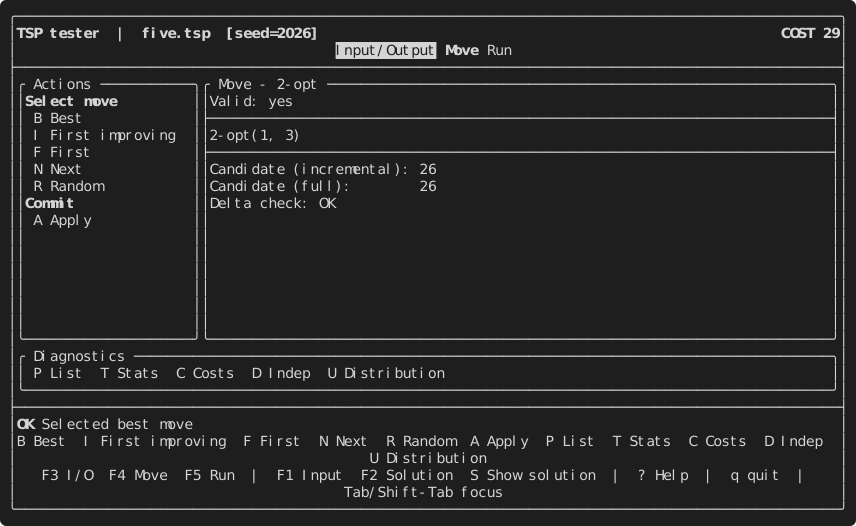
The Input/Output, Move and Run pages replace the old State, Move and Run menus. Use them to load or create solutions, inspect moves and their deltas, edit parameters and watch a search. Chapter 14 describes the controls.
Here the Move page shows the best 2-opt move and its delta check, the counterpart of Perform Best Move followed by a cost check:
To inspect several neighborhoods on the same solution, use a launcher with one app per neighborhood. Build the apps from the same SolutionManager recipe; the launcher carries the Input and current solution between them:
easylocal::tui::run_launcher(
    {
        .title = "EasyLocal TSP Tester",
        .tester =
            {
                .seed = 0,
                .input_path = EASYLOCAL_TSP_INSTANCE_FILE,
                .solution_path = EASYLOCAL_TSP_SOLUTION_FILE,
            },
    },
    tsp::two_opt_app(),
    tsp::swap_app(),
    tsp::union_app());
two_opt_app() and swap_app() are two apps of the TSP example
(examples/tsp/apps.hpp), one with the 2-opt neighborhood and one with the
swaps (chapter 14).
13. A solve in two stages
A common solver first searches on hard constraints until it finds a feasible
solution, then continues on the whole cost. EasyLocal 3 needed two sets of
services for this: one with only the hard components, and one with all of
them. The program connected the stages with solverH.Solve() followed by
solver.Resolve(stage_one.output).
In EasyLocal 4, the solver derives the hard-only stage from a single runner
and its recipes. The example in examples/tutorial/staged_main.cpp treats
TSP edges longer than 8 as violations:
// One hierarchical cost: edges longer than 8 are violations (hard), the
// length is the objective (soft). EasyLocal 3 needed a SolutionManager
// for each set of components (all, hard only); with_hard_cost() derives
// the hard-only runner from this one.
auto sm = el::solution_manager<TourManager>()
    | el::cost::hard_soft(
        el::cost::apply(
            [](double longest) { return std::max(0.0, longest - 8.0); },
            el::component<MaxEdge>()),
        el::component<TourLength>());

// The explorer and its deltas are written once: the hard-only stage
// ignores the delta of the soft TourLength.
auto descent =
    el::make_runner<runners::FirstImprovement>(runners::FirstImprovementParameters{})
    | sm
    | (el::neighborhood<TwoOptExplorer>()
        | el::delta<TourLength, TwoOptLengthDelta>());
This program reads its own parameters because cli::run dispatches named
runners, while this search uses a solver. load_and_apply provides parameter
loading (chapter 10). Set parameters that depend
on the instance after loading the Input and before the solver copies the
runner, as you would with SetParameter after parsing in EasyLocal 3:
// Parameters that depend on the instance, set once it is read, as
// EasyLocal 3's SetParameter("max_evaluations", ...) after the parsing.
const auto tsp = el::load_input<Tsp>(main_parameters.instance);
if (main_parameters.evaluations_per_city != 0)
    descent.parameters().max_evaluations =
        main_parameters.evaluations_per_city * tsp.cities();
solvers::two_stage() replaces the two solvers and the Resolve that passed
the solution from one to the other:
// EasyLocal 3's two solvers, one per SolutionManager, and the Resolve that
// passed the solution from one to the other: the descent on the hard cost
// from a random tour until it is feasible, then on the whole cost.
auto stages =
    el::solvers::two_stage(descent)
        .initialization(el::initialization::random)
        .seed(main_parameters.seed);
const auto result = stages.solve(tsp);
- The first stage evaluates only the components of the hard branch of
cost::hard_soft, and stops as soon as the hard cost is zero; the second continues from its solution on the whole cost. - A delta attached to a soft component,
TwoOptLengthDeltahere, is ignored by the first stage and used by the second. - One runner serves both stages;
two_stage(first, second)takes two, for example with different parameters or neighborhoods. result.iterationsandresult.evaluationsadd up both stages, andresult.stagesreports each one.two_stage()is a pipeline of two stages,(stage("first", descent) & until_feasible()) | stage("second", descent)insolvers: a solver of more stages, each with its own runner, neighborhood and cost, is written the same way (see Solvers). A stage can also be repeated:& attempts(10)on the first one restarts it from new random tours while the tour is not feasible.
The report reads each cost branch separately. To replace EasyLocal 3's
cc.Cost(output), construct a component from the Input and call evaluate:
std::cout << "violations " << result.cost.hard() << ", length " << result.cost.soft()
          << '\n'
          << "iterations " << result.iterations // of both stages
          << ", termination " << el::to_string(result.termination) << '\n';
// The value of each component: components are plain classes, constructed
// from the Input (EasyLocal 3's cc.Cost(out) on each component).
std::cout << "TourLength " << TourLength{tsp}.evaluate(result.solution)
          << ", MaxEdge " << MaxEdge{tsp}.evaluate(result.solution) << '\n';
el::write_solution(tsp, result.solution, std::cout);
$ easylocal_tutorial_staged --main.instance five.tsp --main.seed 1
violations 0, length 26
iterations 3, termination local optimum
TourLength 26, MaxEdge 8
0 4 2 3 1
Checking the port
The compiler catches many integration errors before you run the program: incompatible hook signatures, delta types that cannot be added to their components, missing costs and neighborhoods that do not support the chosen runner. Diagnostics point to the composition and explain what is needed (step 10).
Compilation cannot catch a wrong delta formula or a change in neighborhood
enumeration and sampling. EasyLocal 3 checked these through the MoveTester
menu. EasyLocal 4 also exposes the checks as functions, so you can repeat them
automatically across instances at every build.
Check deltas during a search. Compile with -DEASYLOCAL_VERIFY_DELTAS
(or set it through target_compile_definitions). After each applied move,
the search compares the incremental cost with a full evaluation. The first
disagreement stops the run and identifies the component:
EASYLOCAL_VERIFY_DELTAS: the delta of cost component #1 disagrees with its full evaluation after a move
Full evaluation slows the search considerably, so enable this in debug builds
or tests and disable it for performance measurements
(chapter 5). It is especially useful when
move fields change meaning during the port. Here, EasyLocal 3's TwoOpt
identifies the two edges to remove, while the tutorial uses positions to
locate the segment to reverse.
Test components individually. A fixture contains an Input and the solutions to check. Include a tour with cities out of their original order to expose deltas that confuse positions with city identifiers. Each check constructs the relevant component and returns a report for your test to assert on (chapter 11):
| Check | What it verifies |
|---|---|
check_solution_manager(f) |
the fixture's solutions, the initial one and random ones are valid |
check_cost_component<Component>(f) |
evaluating the same solution twice gives equivalent values |
check_neighborhood<NHE>(f) |
enumerated and sampled moves are valid, keep the solution valid and change it; random moves are enumerated ones, drawn from the generator given |
check_delta_cost_component<NHE, Component, Delta>(f) |
after each valid move, value + delta equals the full re-evaluation |
These functions live in easylocal::testing. Use run_checks(...) to run
several checks and obtain a program exit status. They cover the work of
EasyLocal 3's ComponentTester and the cost checks in MoveTester, making
those checks part of a repeatable test suite.
Check the whole app. check(app, input) builds the app's services and
runs the checks above on initial and random solutions. Its report counts
how many passed:
const auto report = el::check(application, tsp); // also: check(app, input, solution)
el::print_report(std::cout, report);
if (!report)
    return 1;
EasyLocal tsp check: 503 checks passed
composition: solution_managers=1, cost_components=1, neighborhoods=1, delta_bindings=1, runner_registrations=2
It also validates the app's setup: runner names must be distinct and usable on the command line, runners must be constructible from their parameters, and every parameter must declare a domain. The domain check supports tuning; the full list of checks is in chapter 15.
Check a particular solution. A Session holds an Input and current
solution, like the tester. It offers the three familiar MoveTester checks:
Check Neighborhood Costs, Check Move Independence and Check Random Move
Distribution. Each returns counters you can inspect or assert on:
// Each check enumerates the neighborhood of the current solution and
// returns a struct of counters (Session::..._result).

// The delta evaluation of each move against the full evaluation of the
// solution it leads to: moves (enumerated), mismatches (the two costs
// differ), invalid (moves that are not valid or lead to an invalid
// solution).
const auto costs = session.check_neighborhood_costs();

// What each move does to the solution: moves, null_moves (moves that leave
// it unchanged), repeated_states (moves that lead to a solution an earlier
// move reached), invalid.
const auto independence = session.check_move_independence();

// random_move against the enumeration: neighborhood_size (valid enumerated
// moves), samples (draws, 20 per move by default), out_of_neighborhood
// (draws that return no move or one the enumeration does not contain),
// unseen (enumerated moves never drawn), min_frequency and max_frequency
// (how often the least and the most drawn moves came up).
const auto sampling = session.check_random_move_distribution();

if (costs.mismatches != 0 || costs.invalid != 0 || sampling.out_of_neighborhood != 0)
    return 1;
The TextUI exposes these three checks on its Move page and check(app, input)
on its Input/Output page (step 12). You can investigate a problem interactively,
then use the same checks in a regression test.
Parameters, configuration and tuning
In EasyLocal 3, each Parameter<T> was registered in a ParameterBox and
parsed as --box::name. You used IsSet() to check for a value and
SetParameter("name", value) to change it.
In EasyLocal 4, related parameters live in a parameter block: a plain
struct whose fields are easylocal::parameters and whose
parameter_schema()
describes them. Algorithms, temperature policies, tabu lists, cost expressions
and neighborhoods use these blocks. Your classes can use them too:
struct ExcessParameters
{
    easylocal::parameter<double, "bound"> bound{8.0};

    static consteval auto parameter_schema()
    {
        return easylocal::config::fields(
            easylocal::config::field<&ExcessParameters::bound>(
                "Longest edge that is not a violation",
                easylocal::config::range(0.0, easylocal::unlimited)));
    }
};
The default of a field is its member initializer: bound{8.0} here, where
EasyLocal 3 set the default in the constructor of the parameter. A field
written bound{} has no default and must be set, which the parameters whose
value belongs to the problem are: the temperatures of Simulated Annealing and
the budget of a search, which EasyLocal 3 gave arbitrary values.
The schema is read at compile time. It gives each field a description for
--help and the tester, and a domain of allowed values. For example, use
config::range(0.0, 1.0).open(), config::one_of(...) or
easylocal::unlimited for an unrestricted domain.
It can also express relationships between fields. Use .only_if(...) for a
parameter that applies only under a condition, or a requirement such as
config::require(value<"final_temperature"> < value<"initial_temperature">,
"...")
. You declare these rules once; the framework enforces them wherever
parameters are applied. This replaces validation written by hand after parsing
(chapter 10).
A parameter set collects the blocks under paths.
runner.configuration() uses search for the algorithm, cost for the cost
expression and neighborhood for the neighborhood. You can add a prefix:
configuration.add("descent", descent.configuration()) produces paths such
as --descent.search.*.
An app collects the parameters automatically for its registered runners.
With cli::run, use --runners.<name>.* for an algorithm, and --cost.* or
--neighborhood.* for the parts shared by all runners.
| EasyLocal 3 | EasyLocal 4 |
|---|---|
Parameter<double> cooling("cooling_rate", "...", box) |
a field of the block, and a line of its parameter_schema() |
--SA::cooling_rate 0.95 |
--runners.sa.temperature.cooling_rate 0.95, listed by --help with its domain and its current value |
the weights given to each CostComponent constructor |
--cost.weights, the weights of the cost::sum, set without recompiling |
parameter.IsSet() |
nothing to ask: every field has a default, and the diagnostics say what was rejected |
runner.SetParameter("max_evaluations", n) |
runner.parameters().max_evaluations = n, before the runner is bound (step 13) |
CommandLineParameters::Parse(argc, argv, ...) |
cli::run(app, argc, argv), or config::load_and_apply(argc, argv, set) in a program that is not built on an app |
| — | the parameter window of the interactive tester, which edits the same set |
Overrides are validated and applied together. If any value is invalid, all parameters stay unchanged. The command-line program reports the rejected path and reason, then exits with status 2.
The same schema also provides configuration and tuning support, saving you from maintaining separate descriptions of the parameters:
- Configuration files.
--config <file>readspath = valuelines and accepts#comments. Command-line values take precedence. The optionalConfigTOMLcomponent supports TOML, where tables supply path prefixes:[solver.search.temperature]can containcooling_rate. Keep a configuration file alongside your results to record an experiment's settings (chapter 10). - Tuning. In a program using
cli::run,--tuning.irace <dir>exports an irace scenario from the parameters with finite domains. It includes domains, conditions, requirements as[forbidden]expressions and a stub to run the program. Since the scenario comes from the program's schema, you do not have to keep a separate parameter file in sync with its command-line switches (chapter 13). - Domain checks.
check(app, input)catches parameters with no declared domain. Choose a useful domain for tuning: for a temperature,config::range(1.0, 100.0).log()is more useful thanunlimited.
What EasyLocal 4 adds
Once the port works, you can add capabilities that previously required application-specific code:
- Inspect a search with tracing.
easylocal::tracerecords events such as evaluated and accepted moves, incumbent updates, temperature changes and termination. Usememory_recorderin code or save a trace with--trace run.jsonl; JSON Lines and binary ELTR are supported. Tracing is selected at compile time, so disabled tracing adds no recording overhead. Usescripts/eltr.pyto decode saved runs (chapter 17 and Tracing). - Observe and stop a run.
run_controlcombines astd::stop_tokenwith a progress observer. Pass it withwith(control), or set a target and time limit withstop_at(cost)andtimeout(s). Every runner usessearch_runfor progress and cancellation, so a frontend can monitor and stop searches from another thread without changes to each algorithm. - Expose the app over HTTP. The optional
RESTcomponent lets clients submit runs, poll progress, cancel searches and fetch solutions using the same app definition (chapter 16). - Search several objectives.
cost::objectivesdefines a Pareto cost vector, and the run returns the non-dominated solutions it found.runners::ParetoLateAcceptanceHillClimbingsearches for a front (chapter 3). - Compose solvers from stages. Give each stage its own runner, cost and
neighborhood, then add repetition or conditions as needed. You can express
the search strategy without writing a
Solversubclass (chapter 9).
A porting checklist
Before relying on the port's results:
- Run
check(app, input)on a representative instance and the smallest one. - Run a search with
EASYLOCAL_VERIFY_DELTASand resolve any disagreement. - Save a solution, read it back and verify that its cost matches the printed cost. This checks that the I/O hooks in step 4 agree.
- Choose deliberately between
cost::hard_softand a weighted sum (step 6). Check feasibility and account for the difference in Simulated Annealing's behaviour. - Use
--helpto verify parameter values against the old program. Names and defaults may differ. - Check reproducibility with
--seed, then compare the two versions across several seeds. - Declare a domain for every parameter you add, so it passes
checkand can be considered for tuning.
Reference: the two frameworks side by side
The concepts
Use this table to find where each EasyLocal 3 concept belongs in EasyLocal 4 and which step explains the migration.
| EasyLocal 3 | EasyLocal 4 |
|---|---|
Input, Solution and Move (the State of RandomState, PrintState) |
the same three values, plain: no base class, no back pointer to the Input (steps 1 to 3) |
SolutionManager (RandomState, GreedyState, CheckConsistency) |
SolutionManager: random_solution, initial_solution, is_valid — construction and validity only, no cost (step 5) |
CostComponent::ComputeCost |
a cost component's evaluate, with no base class; the recipe attaches it, component<C>() (step 6) |
PrintViolations |
an optional describe(solution) of the cost component, which returns the text instead of printing it |
the hard flag and the weight of a component, HARD_WEIGHT |
a cost expression in the recipe: cost::hard_soft, cost::sum, cost::weighted, cost::in_order, cost::apply, cost::objectives; hard is a level, not a big weight (step 6) |
CostStructure, DefaultCostStructure<CFtype>, the pair violations/objective |
nothing to declare: the cost and its type follow from the components and the expression |
DeltaCostComponent::ComputeDeltaCost, AddDeltaCostComponent |
a delta cost component's delta_evaluate, bound to its component by delta<C, D>() in the recipe (steps 8 and 10) |
NeighborhoodExplorer (FirstMove, NextMove, RandomMove, MakeMove, FeasibleMove) |
a NeighborhoodExplorer with a cursor (first_move/next_move) or a moves() generator, plus random_move, make_move, is_valid (step 7) |
MultimodalNeighborhoodExplorer, ActiveMove |
neighborhood_union, whose move is a variant of the children's moves, with random_biases (step 9) |
ParallelNeighborhoodExplorer (TBB) |
no counterpart (roadmap) |
Kicker, KickerTester |
no counterpart (roadmap) |
Runner subclasses, MoveRunner |
algorithm classes in easylocal::runners with one run member, composed with the recipes into a runner (step 10) |
Solver (SimpleLocalSearch, MultiStartSearch, ...), SetRunner, Solve, Resolve |
easylocal::solvers and their pipelines, or an app whose runners a Session runs by name (steps 10, 11 and 13) |
Tester, MoveTester |
tui::run(app, options), the TextUI adapter (step 12), and the checks of check and of a Session |
ComponentTester |
easylocal::testing, which checks a component against a fixture in a unit test |
ParameterBox, Parameter<T>, CommandLineParameters, SetParameter |
a parameter block per component, with a schema, domains and conditions, gathered in a parameter_set (the parameters) |
Random::Uniform, Random::SetSeed, the global generator |
an RNG passed to the members that need one, and --seed for the run's |
Boost.program_options, TBB |
no dependency beyond the standard library: Core is header-only and parses the command line itself |
The design changes behind these names have practical consequences:
- Smaller component interfaces. Concepts check capabilities at compile time, with no virtual dispatch or required base classes. Implement only the members your algorithms and tools use: an explorer used solely for Simulated Annealing needs random moves but no enumeration.
- Separate state for each search. Services are constructed for an immutable Input and owned by the bound runner. Their constructors can precompute instance data; solution and move values need no Input reference (problem model).
- Reusable cost definitions. Recipes compose cost components and deltas.
The expression keeps hard/soft roles and weights together, making it easier
to try another cost without changing the components. With
cost::hard_soft, soft improvements cannot outweigh a hard violation. - Explicit randomness. Passing RNGs into services makes the source of random choices visible and lets each run control its own generator.
- Less work in custom runners.
search_runsupplies counters, budgets, cancellation, progress and events, so each algorithm can focus on its search decisions. - Earlier integration checks. Missing capabilities are reported where components are composed, with diagnostics describing what to provide.
The runners and the solvers
| EasyLocal 3 | EasyLocal 4 |
|---|---|
FirstDescent |
runners::FirstImprovement (the scan restarts from the first move) |
SteepestDescent |
runners::BestImprovement (ties go to the first best move, not drawn at random) |
HillClimbing |
runners::HillClimbing |
LateAcceptanceHillClimbing |
runners::LateAcceptanceHillClimbing (the history records the current cost, see Runners) |
GreatDeluge |
runners::GreatDeluge |
SimulatedAnnealing (max_neighbors_sampled, max_neighbors_accepted) |
runners::SimulatedAnnealing<temperature::Hybrid>, the same schedule; temperature::Classic is the textbook one, which cools on samples alone and ends at the final temperature |
SimulatedAnnealingOnlyCutoff, SimulatedAnnealingFixedTemperature, SimulatedAnnealingTimeBased |
SimulatedAnnealing with temperature::Cutoff, FixedTemperature, TimeBased |
SimulatedAnnealingWithReheating, ...TimeBased |
SimulatedAnnealing<temperature::Reheating<Hybrid>>, Reheating<TimeBased>; every schedule with an initial temperature can be reheated |
TabuSearch, FirstImprovementTabuSearch |
runners::TabuSearch, runners::FirstImprovementTabuSearch, and AspirationPlusTabuSearch, EliteCandidateTabuSearch |
min_tenure, max_tenure |
a tabu list policy: runners::tabu::FixedLength (one tenure), RandomTenure (drawn in a range), and also Cyclic, Reactive, Frequency |
max_idle_iterations |
max_idle_iterations, in the runner's parameter block, as every other limit |
the Inverse function given to TabuSearch |
inverse(solution, move, tabu_move) in the explorer |
SimpleLocalSearch, MultiStartSearch |
solvers::LocalSearch, solvers::MultiStart |
a solve in stages, written by hand with Resolve |
solvers::two_stage, or a solvers pipeline of stages |
| — | runners::ParetoLateAcceptanceHillClimbing, for a multi-objective cost |
Each algorithm is a class template with its own parameter block, listed in
Runners. To write your own, build on search_run
(chapter 8).
For a concrete extension of SA, follow
Advanced: customizing Simulated Annealing.
It shows EL4's actual search loop, enables the existing Reheating policy,
then writes a new policy that reheats after consecutive rejected moves. The
example keeps the framework's delta evaluation, best-solution tracking,
configuration, cancellation and tracing.
What is not there yet
These EasyLocal 3 features do not yet have a direct counterpart:
| EasyLocal 3 | Planned |
|---|---|
ShiftingPenaltyRunner |
Shifting penalty |
SimulatedAnnealingWithLearning |
Adaptive neighborhood selection |
SampleTabuSearch |
Candidate strategies of Tabu Search |
kickers, VariableNeighborhoodDescent |
Kicks, Iterated Local Search and Variable Neighborhood Descent |
TokenRingSearch |
Cooperative runners, for the runners that exchange solutions; a fixed order of runners is a pipeline today |
GRASP (GreedyState(alpha, k)) |
not planned: a greedy randomized construction is a random_solution of its own, searched by solvers::MultiStart |
ParallelNeighborhoodExplorer |
Parallel search |
the modelling layer (AutoState, expressions) |
A modelling layer, a brainstorming item |
Roadmap items are plans rather than commitments; see API stability.
Next steps
The tutorial builds the same TSP one capability per chapter, and the reference describes every component in full.